Article 185 of the Navy Regulations: Conditions to Fulfill
The Caine MutinyArticle 185 of the Navy Regulations: Conditions to Fulfill defines when a subordinate officer may be vindicated for independently relieving a commanding officer. Its standard is deliberately exacting: the danger must be clear, ordinary recourse to higher authority unavailable, and relief necessary in the judgment of a reasonable, prudent, and experienced officer. The rule makes the act neither a matter of personal dislike nor a simple rejection of orders; it demands a reasoned response to an exceptional threat to the public interest.
Threshold for relief
The article begins from the possibility that a commanding officer’s retention of command could seriously and irretrievably prejudice the public interest. For a subordinate acting on personal initiative to be vindicated, the situation must be obvious and clear enough to admit of only one conclusion: leaving that officer in command would cause that grave prejudice. The rule therefore sets a higher bar than disagreement, unpopularity, or an isolated mistake. The standard is tied to lawful succession. The subordinate taking action must be next in the line of command, and must be unable to refer the matter to a common superior for one of the reasons recognized by Article 184 of the Navy Regulations. Article 184 ordinarily requires approval from the Navy Department or another appropriate higher authority; it permits action without that approval only when delay makes consultation impracticable or another clearly evident reason prevents it. Article 185 thus treats immediate intervention as an exception to the chain of command, not an alternative route for settling disputes.
Investigation and judgment
The subordinate must be certain that the commanding officer’s prejudicial actions do not arise from secret instructions unknown to the subordinate. Before acting, the officer must give the matter careful consideration and investigate all circumstances as exhaustively as practicable. These requirements guard against mistaking incomplete information, unusual orders, or hidden direction for incapacity or misconduct. Even after that investigation, personal conviction alone is insufficient. The officer must be thoroughly convinced that relief follows necessarily from the established facts, and that a reasonable, prudent, and experienced officer would reach the same conclusion. The rule joins urgency to disciplined judgment: circumstances may make referral impossible, but they do not remove the obligation to establish what is happening and why continued command poses an exceptional danger.
Authority and shipboard practice
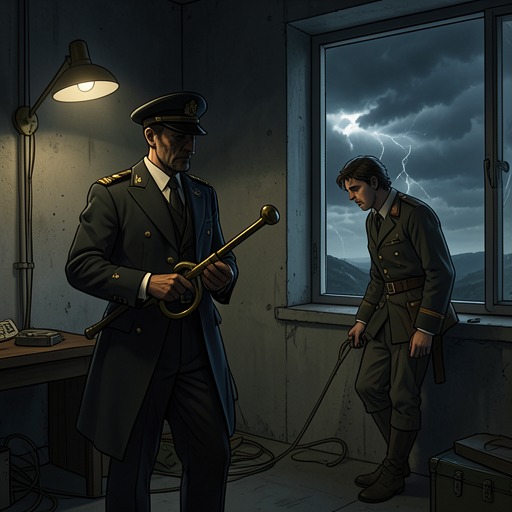
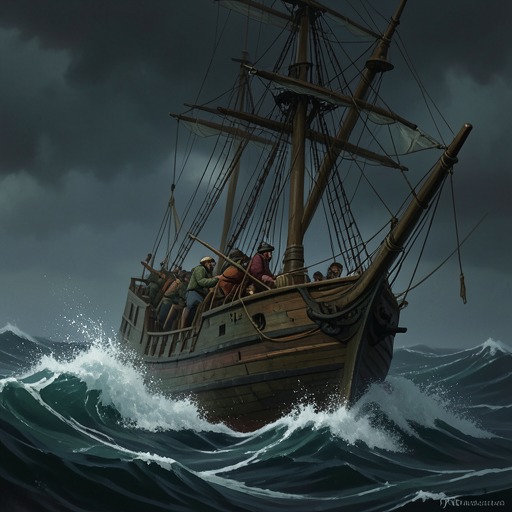
The rule’s stakes are visible in the different ways authority operates aboard the USS Caine. Philip Francis Queeg announces that the ship will follow his way and the book, while also demanding absolute loyalty upward. Yet formal orders do not by themselves ensure effective practice. When a cigarette butt is found in a scupper, he cancels the whole crew’s liberty; the crew then keeps the deck clean within his sight while ordinary conditions persist elsewhere. Steve Maryk recognizes both his duty to enforce the captain’s rules and the practical limits imposed by an overworked, overcrowded crew and the ship’s narrow margin of seaworthiness. He maintains the vessel’s functioning while tolerating a limited circle of visible compliance. Operational decisions likewise involve authority and local judgment together. When the forward fireroom requests permission to blow tubes, Willie Keith relays the request and Maryk, serving as officer of the deck, grants it after checking the flag. Maryk explains how the wind carries soot clear and that a course change would require the captain’s permission. The scene does not itself present a case for relief under Article 185; it shows the ordinary allocation of responsibility against which an extraordinary transfer of command would have to be judged.
Fitness, evidence, and the trial
At Steve Maryk’s court-martial, the question of command fitness is not reduced to a label. Dr. Forrest Lundeen, the Navy hospital’s chief psychiatrist and head of the board that examined Queeg, reports three weeks of observation and testing. In cross-examination, Barney Greenwald recites symptoms including rigidity, feelings of persecution, unreasonable suspicion, withdrawal from reality, perfectionist anxiety, an unreal basic premise, and obsessive self-righteousness. Lundeen characterizes these features as mild and compensated, and explains that a paranoid personality can present with an extremely plausible, convincing appearance of normality. He stresses that the crucial question is whether there is a disabling factor: a diagnosis or personality pattern alone does not establish inability to command. Greenwald then poses a hypothetical about a commanding officer who becomes frightened under fire and runs away, damages government property and denies it, falsifies records, extorts money, and imposes excessive punishments. Lundeen resists treating the list as conclusive without knowing whether the officer otherwise performs his duties satisfactorily. The exchange dramatizes the distinction between identifying troubling traits and proving that they disable a person in a particular command. It complements Article 185’s insistence on investigated facts and a judgment tied to consequences, rather than allowing suspicion or diagnosis by itself to decide the question.
Application and limits
In testimony, Steve Maryk recounts the morning of December 18 in a version the narrative identifies with Willie Keith’s account. Asked whether the ship was in the last extremity when he relieved Philip Francis Queeg, Maryk says that it was. That answer states his judgment of the crisis; the testimony excerpt does not, by itself, establish every statutory condition or resolve the case. Article 185 supplies the demanding framework for evaluating such an act, while the trial’s questions expose the difficulty of applying it: the decision must be made amid urgent circumstances, but vindication depends on the circumstances being examined with care. The article’s significance lies in this balance. It preserves the chain of command by restricting unilateral relief to an unmistakable emergency, while recognizing that obedience cannot require a subordinate to leave command in place when doing so would seriously and irretrievably harm the public interest. Its safeguards make relief accountable to evidence, proper succession, and experienced judgment rather than personal certainty alone.